Tuesday, March 15, 2016

Politics as Usual -- Not

The American Political System is highly dysfunctional. Politics as usual will only bring more of the same. Robert Reich: "[Hillary Clinton is] the most qualified candidate for president of the political system we now have, but Bernie Sanders is the most qualified candidate to create the political system we should have, because he's leading a political movement for change." Can Bernie possibly win in this system we now have? Many think not, yet his opponents are becoming increasingly nervous and his supporters steadily more confident. Will we know more by this evening? We shall see.

FiveThirtyEight predicts that Bernie Sanders will lose in Florida, Illinois, North Carolina, Ohio, and likely Missouri. If correct, they will claim "politics as usual" and argue that the Democratic nominee can now be predicted with some certainty (and it's not Bernie). If their predictions happen to be wrong, on the other hand, they will wring their hands over the "greatest polling errors in history" (except for the time before in Michigan). Either way, we would argue that they are missing the point, which is that this campaign is not about politics as usual. Not by a long shot.

The success of the Bernie Sanders candidacy and the movement he has spawned is largely a result of the Internet.

Community

Bernie Sanders has said, often and in many ways, "This campaign is not about me—it's about all of us. No president can accomplish what has to be done unless millions of people come together." Call it a movement, as he has, or a political revolution, this assemblage of tens, even hundreds of thousands online has become a true community, in fact one of the most cohesive, supportive, vibrant, amazing online communities I have ever witnessed. (And I've been involved in more than a few over three decades, starting with The WELL.)

These are but a few of the many social media pages devoted to the Bernie for president community. and as you may guess there are trolls, disagreements, and arguments. Let me state again, however, that these are among the most knowledgeable, engaged, friendly, supportive, compassionate, helpful, loving people I've had the pleasure of interacting with online. This community counts for a lot, a whole lot.

Campaign

Media

"The revolution will not be televised. ... The revolution will be live." ~Gil Scott-Heron. This slogan is often used both to lament and challenge the fact that Bernie's campaign has been largely ignored by the mainstream media. This has not stopped the message from getting out, however, because there are so many online resources. Here are just a few examples out of dozens, maybe hundreds, more.

Finance

And of course one of the biggest differences in this political campaign is how it is being financed, which is almost entirely by small online donations.


Image credit Kyle O'Leary

Wednesday, November 11, 2015

Changing for Survival

Dr. Luis Contreras (guest)

Our planet is gravely ill and so far there is talk but no action. At a time when we are on a downward spiral, filing lawsuits against the Environmental Protection Agency to delay compliance with Clean Power Plan regulations does not seem like a smart idea. Natural laws, the mysterious and complex ways our planet functions, can't be broken; the laws of nature are final. If we ignore them, we pay for the consequences.

The U.S. Supreme Court says corporations are people with rights protected by the U.S. Constitution. Recently, they got the right to spend money in presidential elections. If corporations have rights, they should have responsibilities like integrity, concern for the environment, and other values we expect from regular people. Some companies have codes of conduct, but they must be optional; corporate behavior is not always what they say. When dealing with survival, people and corporations need to change. We have no other choice.

California is coping with severe drought

We have been lucky so far, and as we reach the end of 2015, life seems good in Eureka Springs. California seems to be ahead of the times. They are making necessary changes to cope with severe drought. We may learn something looking at what California is doing. The changes involve everyone, with rules to use less water, recycle agricultural water, and eliminating water losses. Old pipes, pumps, valves, and all else used to bring water to dry places, built and designed 90 years ago when there was more water for a smaller population, is undergoing maintenance upgrades to eliminate water losses.

Case in point

Two Arkansas wood pellet mills are under construction and scheduled to open in 2016, owned by out-of-state corporations. Wood pellets are on high demand due to what some call an accounting error. To meet pollution standards, coal-fired power plants in U.K. and other E.U. countries are allowed to burn wood pellets pretending it is carbon neutral. This means they only have to account for the carbon footprint of processing and transporting wood pellets. However, the amount of greenhouse gasses from burning wood pellets is higher than burning coal. Not only that, the trees used by the Arkansas pellet mills from private forests will be gone.

The numbers tell the true story. The Monticello Zilkha mill will produce 450,000 tons of pellets per year, using 45,000 acres of forest. With no plans, funds, or resources for re-forestation, a process that takes around 40 years under good weather, the result will be forest soil erosion from severe rains and sedimentation of creeks and rivers. Looking at 2016-2056, the Zilkha "clean heat" wood pellets will destroy 2 million acres of forest in the Monticello area along with the carbon sink provided by the forests. A similar tragedy will happen in the new Pine Bluff wood mill.

For details, please google Climate Central Pulp Fiction. Here is a hint: wood mills, in theory, use sawdust and wood waste; in real life, high-venture investors like Zilkha, the people trying to build the Clean Line transmission lines, target low-income areas where jobs are hard to find. Predatory behavior is unacceptable for individuals and criminal for corporations ignoring the climate emergency. U.S. Congressman Bruce Westerman, in Pine Bluff, is pushing the "Resilient National Forest Act" to make it easy to sell our national forests. If you can, please visit the Ouachita National Forest before it is destroyed. I called Westerman's D.C. office and was told the two new pellet mills in his district are not related at all to the "Resilient Act," please call after reading Pulp Fiction mentioned above, (202)225-3772, they will be expecting to hear from you.

There are no easy solutions to climate change

Some of the people wanting to be our next president offer simple solutions. One of the candidates has been proposing solutions to the hard questions and promises to make structural changes. It is up to us; we need to change, vote and choose survival.

November 10, 2015
Op-Ed, Eureka Springs Independent

Sunday, October 4, 2015

Road to Paris

Paris is mentioned nowhere in the Pope's encyclical Lautato Si'. Yet it is everywhere. By all accounts the Paris Climate Change Conference in December is the primary reason for the timing of the encyclical's release earlier this year and of the Papal visit to the U.S. and the U.N. last month. The central message is that the world must act decisively and we must do so now to address the environmental and social crises we face, especially that of climate change. We are called to repentance and moral action at all levels from individuals on up. Internationally the Paris talks, just a few weeks away, are front and center. The whole world is watching expectantly.

But why is the Paris conference so critical? It occurred to me that most of us know so little about how we got to this point, and much of what I had been aware in the past I have forgotten, so I decided to dig deeper. In what follows, I use acronyms to save space, but you can see what the acronyms stand for by hovering your cursor over each one.

1972. The Stockholm Declaration was issued by the United Nations Conference on the Human Environment (UNEP).

1988. The IPCC was established by two UN organizations, the WMO and the UNEP to provide an internationally accepted authority on climate change, producing reports which have the agreement of leading climate scientists and the consensus of participating governments.

1990. The IPCC issued FAR which stated with certainty that emissions resulting from human activities are substantially increasing the atmospheric concentrations of the greenhouse gases, resulting on average in an additional warming of the Earth's surface. This report was the basis of the UNFCCC.

1992. "Earth Summit" (UNCED) in Rio de Janeiro negotiated the UNFCCC, an international environmental treaty to "stabilize greenhouse gas concentrations in the atmosphere at a level that would prevent dangerous anthropogenic interference with the climate system". Pope Francis does mention this conference (167): "Although the summit was a real step forward, and prophetic for its time, its accords have been poorly implemented, due to the lack of suitable mechanisms for oversight, periodic review and penalties in cases of non-compliance. The principles which it proclaimed still await an efficient and flexible means of practical implementation." After 1995, the Parties to the Convention agreed to meet annually (COP).

1997, COP3. The Kyoto Protocol extended the UNFCCC to set emissions targets (in broad outline) for developed countries which are binding under international law, based on the principle of common but differentiated responsibilities. The first commitment period was from 2005-2012. The U.S. is a signatory, but has never ratified the Protocol.

2007. The IPCC issued AR4 calling for an initial target of 25 to 40 percent reductions below 1990 levels by the year 2020 and a peak and decline within the next 10-15 years.

2007, COP13. The Bali Roadmap marked a milestone in the process of international consensus building, setting forth a multilateral legal framework to address climate change. The process was acrimonious, however, with the US delegation systematically derailing negotiations throughout. In the end, the US removed its block on the final text, but the US still refused to allow numbers into the Bali Action Plan's nonbinding preamble. As a compromise, the Bali Action Plan's sole footnote refers to the volumes and page numbers where the 25 to 40 percent reductions in emissions appear in the IPCC AR4. A two-year process was outlined to finalize a binding agreement in 2009 in Copenhagen.

2009, COP15, The Copenhagen Summit. According to the Bali Road Map, a framework for climate change mitigation beyond 2012 was to have been agreed here. Expectations were high. On the final day of the conference, international media reported that the climate talks were "in disarray". In lieu of a summit collapse, The Copenhagen Accord was drafted by the United States, China, India, Brazil and South Africa. It was "taken note of", but not "adopted", in a debate of all the participating countries the next day, and it was not passed unanimously. The document recognized that climate change is one of the greatest challenges of the present day and that actions should be taken to keep any temperature increases to below 2 °C. The document is not legally binding and does not contain any legally binding commitments for reducing CO2 emissions. So much for the Bali Roadmap.

2010, COP16. The Cancún agreements were hardly disappointing after the Copenhagen fiasco, but still minimal progress was made. The agreement reiterated that climate change is one of the greatest challenges of our time and that all parties must share a vision for long-term cooperative action in order to achieve the objective of the Convention, including the achievement of a global goal. It included a "Green Climate Fund" to assist poorer countries in financing emission reductions and adaptation, but there was no agreement on how to extend the Kyoto Protocol, or how the funds for the Green Climate Fund will be raised, or whether developing countries should have binding emissions reductions or whether rich countries would have to reduce emissions first. The agreement "fell woefully short of action needed."

Anyone see a pattern yet?

2011, COP17. The Durbin Platform: After two weeks of negotiations and a 60-hour marathon session, on the last day negotiators agreed to be part of a legally binding treaty to address global warming. The terms of the future treaty are to be defined by 2015 (COP21) and become effective in 2020. Considered by many as too little too late, this is our last best hope, which is why the Paris Climate Summit is so extremely crucial. If the world cannot reach such an agreement then, we will have committed the future of our planet to one of horror.

2012, COP18. The Doha Conference agreed to extend the Kyoto Protocol, due to expire at the end of 2012, until 2020, and to affirm the 2011 Durban Platform that a successor to the Protocol is set to be developed by 2015 and implemented by 2020. It also formalized the concept of "loss and damage", a recognition of liability.

2012, "RIO+20". The UNCSD is not officially part of the UNFCCC process, but in marking the twenty-anniversary of the first Earth Summit in Rio de Janeiro, it raised high expectations, only to disappoint. Pope Francis (169): "RIO+20 issued a wide-ranging but ineffectual outcome document. International negotiations cannot make significant progress due to positions taken by countries which place their national interests above the global common good. Those who will have to suffer the consequences of what we are trying to hide will not forget this failure of conscience and responsibility."

2013, COP19. Statement by WWF, Oxfam, ActionAid, the International Trade Union Confederation, Friends of the Earth, and Greenpeace :"Organizations and movements representing people from every corner of the Earth have decided that the best use of our time is to voluntarily withdraw from the Warsaw climate talks. The Warsaw climate conference, which should have been an important step in the just transition to a sustainable future, is on track to deliver virtually nothing."

The pattern continues.

2014. IPCC issued AR5.

  • Warming of the atmosphere and ocean system is unequivocal. Many of the associated impacts such as sea level change (among other metrics) have occurred since 1950 at rates unprecedented in the historical record.
  • There is a clear human influence on the climate.
  • It is extremely likely that human influence has been the dominant cause of observed warming since 1950, with the level of confidence having increased since the fourth report.
  • The longer we wait to reduce our emissions, the more expensive it will become.

2014 September, Leaders Climate Summit. UN Secretary-General Ban Ki-moon invited world leaders, from government, finance, business, and civil society to Climate Summit 2014 on 23 September in New York City to galvanize and catalyze climate action. He asked these leaders to bring bold announcements and actions to the Summit that will reduce emissions, strengthen climate resilience, and mobilize political will for a meaningful legal agreement in 2015.

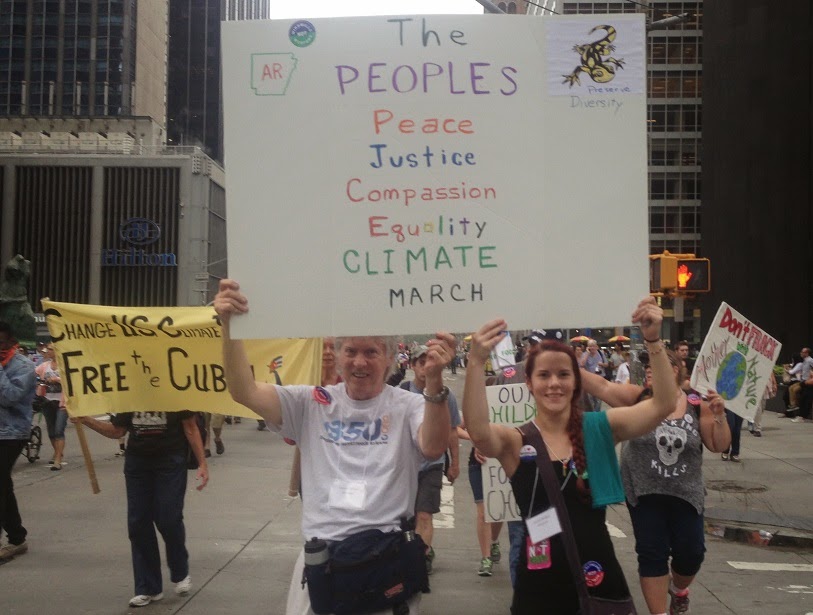
2014 September, People's Climate March. The day prior to the Leaders Climate Summit, over 300,000 people (maybe 400,000) took to the streets of New York City to demand real climate action. It was endorsed by over 1500 organizations, and it has catalyzed an ongoing and growing grass roots movement around the world ever since, the People's Climate Movement.

2014 December, COP20. Work on the draft agreements for Paris began.

2015 December, COP21. "In 2015, France will be hosting and presiding the 21st Session of the Conference of the Parties to the United Nations Framework Convention on Climate Change (COP21/CMP11), otherwise known as 'Paris 2015' from November 30th to December 11th. COP21 will be a crucial conference, as it needs to achieve a new international agreement on the climate, applicable to all countries, with the aim of keeping global warming below 2°C. France will therefore be playing a leading international role to ensure points of view converge and to facilitate the search for consensus by the United Nations, as well as within the European Union, which has a major role in climate negotiations.".

Friday, August 28, 2015

Abortion and Ecology

Since everything is interrelated, concern for the protection of nature is also incompatible with the justification of abortion. ~Pope Francis, Praised Be: On Care for Our Common Home, §120.

Having now read Praised Be several times, I am slowly working my way back through the Encyclical section by section. Today I reached §120, where I was confronted by the sentence quoted above. Since the entire section isn't that long, let me quote it in its entirety.

Since everything is interrelated, concern for the protection of nature is also incompatible with the justification of abortion. How can we genuinely teach the importance of concern for other vulnerable beings, however troublesome or inconvenient they may be, if we fail to protect a human embryo, even when its presence is uncomfortable and creates difficulties? "If personal and social sensitivity towards the acceptance of the new life is lost, then other forms of acceptance that are valuable for society also wither away".

The sub-quote at the end is from Pope Benedict's Encyclical Letter Caritas in Veritate (Charity in Truth) (29 June 2009), §28.

Openness to life is at the centre of true development. When a society moves towards the denial or suppression of life, it ends up no longer finding the necessary motivation and energy to strive for man's true good. If personal and social sensitivity towards the acceptance of a new life is lost, then other forms of acceptance that are valuable for society also wither away. The acceptance of life strengthens moral fibre and makes people capable of mutual help. (Emphasis in the original.)

These principles resonate with me, so where do I stand on abortion?

I was in medical school when the landmark Roe v. Wade decision was handed down by the U.S. Supreme Court. Young as I was, I applauded this legal decision at the time, and I've supported it throughout my medical career. I support it today. So how do I reconcile this stance with my growing concern for all vulnerable beings?

As I started writing this, my plan had been to articulate a nuanced defense of my position. Instead, I've now decided to leave the question open, to continue wrestling with it. How should our society encourage reverence for life? How do we overcome our culture of violence? How do we learn to live together with respect and dignity, and with compassion?

Friday, August 7, 2015

NOT a Climate Scientist

Pope Francis, I am told, is trained in chemistry but he is not a climate scientist. This I have in common with him. I too have a degree in chemistry and am not a climate scientist. He and I cannot presume, therefore, to speak on climate from a position of scientific authority, but we trust the scientific method and understand its limitations and strengths, a perspective which is helpful. Otherwise we are not much different from everyone else. All of us depend on climate scientists to help us understand what is going on.

As a scientist who is not a climate scientist, here are my thoughts on climate change.

1. The science of weather and climate is extremely complicated.

Weather is the behavior of the atmosphere at a given location at a specific time. This is influenced by conditions of the land and water beneath it, as well as the weather in surrounding regions. Weather systems, therefore, are dynamic, non-linear (chaotic) interactions among enormous numbers of variables, few of which can be known with any certainty. It is small wonder weather forecasting is notoriously capricious. Yet it is surprisingly reliable. I recall as Hurricane Sandy was approaching the Eastern Seaboard, forecasters said over and over, we don't know what to expect because we have never seen a storm like this before, but the predictions were nonetheless uncannily accurate. Chaotic systems are not unpredictable. Recognizing the chaotic, fractal nature of our world gives us new insight, power, and understanding.

Climate is weather over longer periods of time and typically over wider regions. The region of interest may even be global and the time period as long as decades or centuries. But if weather is difficult to forecast, surely climate must be impossible. It turns out, however, that trends are easier to predict than the details, not simple, mind you, just less difficult. Climate systems such as El Nino, though, are notoriously difficult to forecast. This week I read reports that despite strong similarities between the 2015-16 and 1997-98 El Nino events, expert forecasters are refusing to make specific predictions.

All this is to emphasize that climate and weather are complicated. Computer modeling has a special fascination for me. Because the number of variables is so enormous, computer modeling even a few years ago was limited by memory costs and processing speed, but these boundaries seem to fall every year if not every month. Our computer models are now more accurate than ever, and often they are more disturbing. The latest predictions are more dire than the conservative estimates of just a few years ago. Yes, all this is complicated and much remains unknown, but the uncertainty is troubling not comforting. What we don't understand may be acceptable, ... probably not.

2. The science of man-made global warming is really simple.

(1) By contrast, the thermodynamics (physics) of green house gases (carbon dioxide, methane, water vapor, and others) has been well studied for over a century and is well understood. This has not been nor is it now in dispute. (2) The concentration of carbon dioxide and other green house gases in our atmosphere has been (and still is) steadily increasing. This is not in dispute. (3) The total heat content of the earth has steadily and dramatically increased since at least 1980. Yes it has been disputed that surface atmospheric temperatures have increased since 1998, but (a) in 1998 an abnormally strong El Nino caused heat transfer from the Pacific Ocean to the atmosphere, (b) even so ten of the hottest years on record have happened since 1998, (c) many high temperature records (and many fewer lower temperature records) have been broken since then, and (d) the steady rise in ocean temperatures since 1980 is undisputed. The earth is getting warmer, and the increase can be directly related to the increase in greenhouse gases in the atmosphere. Weather and climate predictions are actually harder than rocket science; the physics of global warming is not. It is straightforward.

3. The scientific consensus on climate change is crystal clear.

Consensus does not always guarantee truth, but scientific consensus is hard to come by and often it is associated with truth. It is the nature of science to be self-correcting. Individual scientists are not above error in judgment or interpretation, nor are they flawless even in groups, but science is truth seeking. The overwhelming consensus today is that man-made global warming and climate change is real, and it is serious. This consensus is demonstrable in at least two ways. First, more than 97% of those publishing in the area (as many as 99.9%) are in full agreement. Climate change is real, and human activity is the cause. Second, nearly every major scientific body in the world has issued such a statement. Scientific organizations are typically conservative about making such statements, so this is nearly unprecedented and significant. The notion that this is in debate is fabricated by the deniers.

4. The politics of climate science denial is all too familiar.

Here I have some personal experience. Not a lot, because I am a pediatrician, but when I was in medical school the surgeon general issued his statement about the health risks associated with cigarette smoking, and for decades big tobacco companies spent billions denying the science that was well established. Millions of people lost their lives unnecessarily as a result. Some of the same public relations firms are now involved in denying global warming and defending the fossil fuel industry. I am offended by this.

5. The consequences of climate change are already horrifyingly apparent.

So where do I start? The problem is that individual local crises are hard to connect to global "climate change." But honestly, these many disasters are becoming so severe and so commonplace, so "normal", that one can no longer imagine they are unrelated to what we have done to the earth and its climate. Moreover, the connections are often now becoming clearer.

A partial and less-than-systematic list of possible consequences would include: more powerful and dangerous hurricanes and tornadoes, drought and wildfire, intense rainstorms and flooding, deadly heat waves, bad air, allergies, asthma, infectious disease and food and waterborne illness outbreaks, ecosystem shifts and species die-gff, melting glaciers, early ice thaw, sea-level rise, and less fresh water.

Wednesday, June 3, 2015

Watershed Pilgrimage

The Paris Climate Conference (COP21) in December is shaping up to be a "watershed event" according to the Director for Strategy at the UN Climate Change Secretariat (UNFCCC). What does this mean? The word watershed can mean either "a drainage area" or "the ridge dividing two drainage areas." In this case, the Paris Agreement is an opportunity for Governments to set aside their differences and join forces to chart a course avoiding further disruption to our only climate system OR failing that humanity will continue its relentless plunge the other way toward destruction. This Conference will be a watershed moment. Hold that thought.

The #PeoplesPilgrimage is an open source response from the human heart to the climate crisis. It's a way for everyone - of all faiths and none - to share our hopes and fears, and call for action on climate this year. Arkansas Interfaith Power and Light would like to plan and host an Arkansas Pilgrimage between now and December. We are open to suggestions for local or regional sacred places we want to protect from destruction of climate change.

Short of a better idea, what about this? The Arkansas House of Prayer is an interfaith haven set apart in nature, dedicated to contemplative prayer, meditation, and quiet. It also happens to be located precisely on a natural watershed. Rain on the north side flows to the Arkansas River by way of the Maumelle and Little Maumelle Rivers, whereas rain on the other side flows into the headwaters of Rock Creek and on south, then east to the Arkansas River by way of Fourche Creek. What if we were to use this (interfaith) sacred place and natural watershed as a symbol of the crucial "watershed" nature of COP21?

My suggestion would be for us to gather on the grounds of the House of Prayer for an opening ceremony, after which a small contingent would walk down Chenal Parkway north toward Chenonceau Blvd. The rest would walk south on the path along Chenal Parkway toward Rock Creek. It is two miles to Promenade at Chenal. Maybe we could rent one of the theaters at Chenal 9 IMAX for a documentary or a rally (or both). The group walking north to Aberdeen Court would bring a van back to the Promenade.

Tuesday, April 7, 2015

Fun in the Sun (and Snow)

Just for fun (I've been too serious lately) here is a wild idea. How about asking Arkansas Children's Hospital (ACH) to cover the top level of the parking deck? The top deck was closed for days this winter due to ice and snow, with a few falls anyway, so doesn't it make sense to cover it? Moreover we could stand some protection from the sun on unbearably hot Arkansas summer days and drenching rain storms.

The Proposal

David Berry (our COO) and Gina Wingfield (our CFO) would say this is a great idea if we had the money, but there are higher priorities for spending than our comfort (and occasionally our safety). But what if I were to tell them and you that it wouldn't have to cost us a dime? The details are somewhat more complicated, but the concept is spectacularly simple. A photovoltaic (PV) solar panel pays for itself in twenty years (typically, and maybe as short as ten). That's it! That is my great idea.

Complications

  • Providing protection from the sun is straightforward; that is what 'solar' panels do essentially. Using panels to protect from ice and snow requires more creativity, but it can be done.
  • The generating capacity for commercial customers for net-metering rules would be limited to 450 kW, which would be around 1800 panels. These would only cover about 180 parking spaces or ¾ of the top level.
  • Connecting to the grid will require careful coordination with Entergy, including review of the net-metering agreement and a specific contract with Entergy up front (above my pay grade). Maybe we can negotiate a higher limit at the same time.

Are you kidding?

No, I am serious. Well I am having fun, of course, but I'm serious too. Moreover, I am not the first to think of this. Maybe the first at ACH (or not, I don't know), but similar projects are already underway, for example, at UT Southwestern Medical Center and at the VA Hospital in Little Rock. The VA project has been delayed, but I'm told it is now a matter of working out a few final details. It is a big (huge) project, after all, at least five times larger than the one I am suggesting.

Although Arkansas lags behind the rest of the country, the amount of electricity generated by U.S. utility-scale solar photovoltaic power plants is up more than 100 percent in 2014 over the same period in 2013, and it is predicted to double again within the next two years or less. Solar power is no longer a risky proposition. ACH is wise not to be the first (and it's not) but it should be among the leaders for this trend.

Why should ACH take the lead?

Above I suggested that solar panels would be a cost-effective way to provide protection from the elements (sun, rain, snow, and ice) for a few vulnerable parking spaces, but there are more compelling reasons that ACH should lead out in such a project.

Asthma

The CDC estimates that the prevalence of asthma nation-wide is around 8%. In Arkansas this number tends to be higher, around 13%. Among 9th through 12th graders in Arkansas, the prevalence may exceed 20%. In any case asthma among kids, especially teenagers, is a serious problem in Arkansas. The causes are multi-factorial, true, but without necessarily claiming a direct cause-effect relationship, coal-fired power plants are known to be major sources of particulate and sulfur dioxide pollution that trigger asthma, of which there are four in Arkansas. (One of these is said to be "clean" while another is listed among the dirtiest, but all contribute.)

If any institution in Arkansas should lead out in promoting clean air by cutting back on coal-fired power, it should be Arkansas Children's Hospital. Yes, 450 kW is just a drop in the bucket but not insignificant, nor would its impact be trivial. It is a start, a good start, and along with the VA Hospital we could make a profound statement for change. Yet clean air is not the half of it. Coal-fired power plants also emit carbon dioxide, a green-house gas, which is a major contributor to climate change.

Climate Change

Experts with the American Academy of Allergy, Asthma & Immunology (AAAAI) believe climate change plays an even bigger role in allergies and asthma than what is being reported. "Climate change has the potential to affect all aspects of allergen exposure, including both indoor and outdoor allergens, as well as communicable diseases that are related to allergies and asthma." Beyond that, the World Health Organization estimates that more than 80% of the health burden due to climate change occurs in children less than 5 years old. As early as 2005, the American Academy of Pediatrics (AAP) warned that "there is broad scientific consensus that Earth's climate is warming rapidly and at an accelerating rate. Human activities, primarily the burning of fossil fuels, are very likely to be the main cause of this warming." They went on to state that "because of their physical, physiological, and cognitive immaturity, children are often most vulnerable to adverse health effects from environmental hazards." Since then the AAP has reaffirmed these statements several times, as late as July 2014.

If any institution in Arkansas should be concerned about the health and well-being of our children and theirs it is Arkansas Children's Hospital. We cannot turn a blind eye to the many different forms of global destruction that will result from global warming caused by our addiction to coal and other fossil fuels. It will have a direct and indirect impact on the children of our state, and even devastating impacts on children around the world. How can we fail to do everything in our power to change the direction in which our world is heading?

There are powerful entities in our state that will try to tell you this is all political hype. They will claim there has been no warming for over fifteen years, or that the warming we've seen is natural variation unrelated to human activity. They will state that scientists disagree with each other and that there is still much debate about climate change. Or they will insist that reducing our use of fossil fuels would be an economic disaster, especially for developing countries. They will say anything they can to promote the continued use of their fossil fuel assets for as long as possible. Many of the medical staff at ACH are old enough to remember the same tactics used by big tobacco forty years ago to hold onto their profits. Don't believe them.

If any institution in Arkansas should accept the evidence of science on climate change it is Arkansas Children's Hospital. When we want to provide the best care for our patients we seek out the best scientific evidence we can. We follow the best experts we can find. If the evidence is equivocal we hold off and are (or try to be) patient, but when the evidence is clear we act upon it. My friends, there is ample evidence on climate change. Scientists by nature are conservative, scientific organizations even more so, but nearly every significant scientific organization in the world has issued a statement that climate change is real and that human activity is responsible. Well over 90% of the climate experts in the world agree (97% actually). To suppose that all of them are wrong (or part of a conspiracy) is foolhardy. And for those of you who wish to examine the evidence for yourselves, please let me know. I promise you, it is both impressive and convincing.

The Mission of ACH

The Mission of ACH is to "champion children by making them better today and healthier tomorrow." How can we fail, therefore, to do everything possible to mitigate climate change and its potential to devastate our children and theirs beyond anything we now imagine? How can we not do everything in our power, including actions that might be politically controversial, to change the tide?

Okay, so maybe we are not quite there yet. What we can do, however, is something less controversial and much less risky, such as installing a few solar-panel covered parking spaces. This proposal is a win-win. It protects our employees, pays us back over time, and makes a positive statement about clean energy generation. We can wait until the following year (or the next) to picket the Foundation to divest its fossil fuel holdings or the EPA to further tighten its clean air standards. As I said above, removing 450 kW from the grid seems precious little, but it would say (and do) more than you might think.

Did I say something about not being so serious? Oh well.

Monday, February 16, 2015

Carbon Sequestration

The snow day is nearly over, but I learned something today I'd like to pass along. The term "carbon sequestration" can have at least two different meanings.

Soil Carbon Sequestration

Soil carbon sequestration is a process in which CO2 is removed from the atmosphere and stored in the soil carbon pool by plants through photosynthesis, with carbon stored in the form of soil organic carbon (SOC).

Since the industrial revolution, the conversion of natural ecosystems to agricultural use has resulted in the depletion of SOC levels. This is the combined result of reductions in the amount of plant roots and residues returned to the soil, increased decomposition from soil tillage, and increased soil erosion. Depletion of SOC stocks has created a soil carbon deficit that represents an opportunity to store carbon in soil through a variety of land management approaches. However, various factors impact potential soil carbon change in the future, including climatic controls, historic land use patterns, current land management strategies, and topographic heterogeneity. (Todd A. Ontl & Lisa A. Schulte, 2012)

Carbon Capture and Sequestration Technology

Carbon capture and sequestration (CCS) technology is the process of capturing waste CO2 from large point sources, such as fossil fuel power plants, transporting it to a storage site, and depositing it where it will not enter the atmosphere, normally an underground geological formation. (See EPA on CSS.) The energy requirements of sequestration processes may be significant (up to 25% of the energy output or more). By the industry's own admission, on a practical scale the hurdles are still enormous. Moreover, it would only work on point sources.

What I learned today, then, is that neither form of carbon sequestration is currently feasible on a large scale. But soil carbon sequestration is not only a potential means of reclaiming atmospheric CO2, but more importantly it is a way to reclaim our rapidly depleted soil. Carbon capture and sequestration technology, on the other hand, is merely an attempt to mitigate the continued use of fossil fuels using technology that is still prohibitively expense and of unproven safety.

Thursday, January 15, 2015

Open Letter II to Senator Boozman

Senator Boozman,

A few days ago I wrote to you expressing my concerns about the Keystone XL Pipeline. Your answer seemed familiar because we've had much this same exchange before. This time you wrote:

Thank you for contacting me to express your views regarding the Keystone Pipeline. It is good to hear from you.

I understand the many diverse opinions that have been expressed about the pipeline. I feel strongly that we need to make sure that the transportation of fuels and energy is carried out in the safest manner possible. I also believe we should use the vast energy resources we have in North America to lower gas prices and lessen our dependence on foreign oil from unstable regions. This pipeline would add more energy to the supply lines while creating and sustaining jobs. American manufacturers need access to affordable energy so that our country can remain competitive. The best way to lower gas prices for Arkansas families is to rely on North American resources.

Also, the Canadians are developing their resources, so the question is whether our country will benefit or whether those resources will go to our competitors, like China. We must also consider that when oil is not shipped by a pipeline it is often moved by other methods of transportation, like railroads. While we may not see completely eye-to-eye on this issue, you should know that I respect your views. At this time, the federal government has not made a final decision on the pipeline. Please know that I will keep your concerns in mind as we move forward debating energy issues like this pipeline.

Again, thank you for contacting me on this very important issue. Please be sure to visit our website at www.boozman.senate.gov . I look forward to your continued correspondence.

Sincerely,
John Boozman
U.S. Senator

See how similar it is? Senator, it seems clear that you did not read my previous reply because you have not answered any of the challenges raised there. Rather than just repeat them, however, let me take a different approach.

First, please know that I have not always opposed the Keystone XL Pipeline. Prior to 2013 I was uninformed and fairly neutral. I knew there were environmental concerns, but I also thought there were economic and safety reasons why a new pipeline would be worth the risks. The Mayflower Oil Spill changed all that for me, not because it was such a terrible disaster -- as environmental disasters go, it was not nearly the worst -- but it took that event to jar me from my apathy to examine the issues for myself. My previous response to you grew out of that personal study.

Second, I am extremely concerned that science has become so badly distorted and denigrated in our society, particularly among leaders such as you. This reminds me of when I was in medical school and the science of tobacco health risks were belittled by Big Tobacco. Surely you remember this yourself. Millions of people lost their lives because of this. Spreading doubt and denial was extremely costly then and it is more so now. Senator, why do you follow this same path today? You can hide your head in the sand, but the scientists are in 97%(+) agreement, and you are on the wrong side of this one. Science is NOT an opinion poll. It always catches up. As a scientist I beg you to take the science seriously.

If you still "look forward to continued correspondence" I would appreciate hearing your answers to the specific questions I raised before, and if need be I would be happy to bring them to your attention again.

Sincerely,
Donnal Walter, MD, PhD

Saturday, October 18, 2014

Watershed Discipleship

St. Margaret's Church, situated on the eastern extent of Shinall and Crystal Mountains, lies on a natural divide. Rain north of the church flows to the Arkansas River by way of the Maumelle and Little Maumelle Rivers, whereas rain on the opposite side flows into the headwaters of Rock Creek and on south then east to the Arkansas River by way of Fourche Creek. A ridge of mountains like this between two water ways is called a watershed. By analogy a "watershed moment" is a crucial dividing line or turning point when an outcome could go either way. We live in such a time.

The Watershed Moment

"Life, a miracle in the universe, appeared around four billion years ago, and we humans only two hundred thousand years ago. Yet we have succeeded in disrupting the balance that is so essential to life. In fifty years, in a single lifetime, the Earth has been more radically changed than by all previous generations of humanity." (Home) The decisions we make in the remainder of this century, especially the next few decades, will determine the survival of civilization, possibly even our species and certainly others. I refer not only to green-house gas emissions with resulting global warming and climate change, but to other forms of pollution of air and water, to never-ending war and violence in our streets and in our homes, to discrimination, oppression, exploitation, and inequality. This watershed moment calls for nothing short of radical discipleship, not denial.

Taking a Stand from My Watershed

The word "watershed" also has another meaning. It is the area of land that drains all rainfall and streams to a common outlet. I mentioned two of these above, one north and one south of St. Margaret's. The USGS has created a hierarchical system of watersheds, or hydrologic units, each assigned a unique code (HUC). The watershed containing Rock Creek and Fourche Creek is designated HUC 1111020702. It is one of six watersheds that make up the Lower Arkansas-Maumelle sub-basin (HUC 11110207). Another is the north slope of Shinall Mountain, which contains the Maumelle and Little Maumelle Rivers (HUC 1111020701). Why is this important?

Water is essential for life. All living plants and animals are inextricably linked to the natural flow of water within a bioregion (life territory), and although we try to insulate ourselves through a grid of waterlines to every location where we use water, we cannot escape these intricate connections between life and the flow of water. It has been, in fact, our attempt to shield our lives and our actions from our profound interconnectedness with the Earth that has led to the wanton destruction we see (or too often refuse to see) around us. In this way, the profound global issues facing us remain abstract and diffuse.

How can we care for the planet without caring for its millions of natural neighborhoods, each one different and distinctly precious from the others? Watershed Discipleship is based on persuasion "that the best way to orient the church's work and witness is through bioregionally-grounded planning and action which focuses on the actual watersheds we inhabit. Because this orientation is still foreign to our Christian communities, our task is to nurture watershed consciousness and engagement in our faith traditions. "

Becoming a Disciple of My Watershed

My watershed has much to teach me about interrelatedness and resiliency, but I am surprised at how little I know about it. Over the coming weeks I intend to rectify that.

Friday, October 17, 2014

Rel B. Corbin, Guest

Peoples Climate March—my experience. I was #112, the last person to be accepted for the Arkansas buses to NYC. We left LR very early Friday morning, stopped at Oak Ridge, Tennessee for a program on Global Warming . Some of us had signed up too late for a security clearance to enter Oak Ridge so we had to spend that time on a nice beach on the Clinch River miles upstream from the ash dump at Kingston, TN.

We spent the night at the hamlet of Bulls Gap, TN, where we picked up the last to join us. We had folks from all over Arkansas and from Oklahoma, Missouri, Tennessee, Mississippi, and Alabama. Ages ranged from early teens to around eighty. Families came.

Up early Saturday, to go the length of the Virginia's Shenendoah Valley, very briefly across West Virginia and Maryland and then half the length of Pennsylvania to arrive at Rochelle Park, NJ that night and up early Sunday morning to arrive beside Central Park in NYC to wait for our parade to start at 11:30. Many people were already there when we arrived about 7 AM. We had agreed to stay together, so we scattered. I was with a little core group but I would wander off among the people and out into Central Park occasionally (Central Park is huge with big overgrown areas. There were plenty of porta potties for 200,000 but not near enough for the 400,000+ who participated. I have found I was not the only one to water the bushes in wonderfully over grown areas.)

There were Vegans, Pacifists, Socialists, Communists, Lenin-Marxists, others strongly opposed to all these and then there were others. There were all colors of folks. I talked with a Pine Bluff, Arkansas native NAACPer who brought several teenagers from Milwaukee.

Sometimes New Englanders and New Yorkers would ask where I was from, I assumed because of my Arkansas twang, but I felt they were just curious. Folks were very nice. And interested to talk with someone from Arkansas.

I never felt pushed, physically or otherwise in New York.

There were cops everywhere. My seat mate for the trip, Guerlermina, was from Monterey, Mexico via Chicago and eastern Oklahoma, good Catholic, widowed in 1972 with 5 young children, who recently married a Republican Methodist. Mina got her photo taken twice with pairs of cops holding her arms from either side, all grinning.

This was an exhausting trip. I never heard a speech that moved me. But I felt the whole time (until the Monday night at 10:30 arrival back in Little Rock.) that this mass of people, many of whom probably sacrificed greatly to go, want to save God's Green Earth from the eminent disaster, (referred to as "Progress" by many) we are close to.

I am ready to go again.

By Rel B. Corbin, guest post.
Join us on Friend to Friend on Climate
 

Thursday, September 25, 2014

Ryan Boswell, Guest

The People's Climate March was far and away a greater success that I ever could have imagined. My experience started at 5AM the Friday before the march. I jumped on a bus that would caravan from Little Rock with more than one hundred others from around the region. On the way to New York, we divided the drive into two days, and picked up a handful of passengers on the route from Arkansas across Tennessee. We stopped for the day after the first twelve hours of driving, which destined us for a visit to the Climate Change Science Center at Oak Ridge National Laboratories. We heard from three climate scientists about the impacts of climate change in the Arctic Circle and how trees are responding to increased temperature and atmospheric carbon. It was truly fascinating work – enough to keep one hundred people engaged after twelve hours on a cramped bus.

The next day we made the long and uneventful drive to outskirts of New York, where we rested up for the Sunday's big event. We woke early and traveled into the city. In a way it was eerie how quiet New York was that morning; the city that never sleeps seemed to be in a trance, as if it already knew what was going to unfold. Police and march organizers were everywhere, skillfully coordinating the more than 500 buses traveling from around the country. We were off the bus with three hours to go before the march began, but already the route was buzzing with people. I walked up and down Central Park West to get a handle the crowd.

I couldn't believe my eyes. People impassioned by all manner of issues were joining together under the common cause of climate change. The crowd was so diverse and sometimes at odds: from peace-loving grandmothers to youth demanding a climate-just future; anti-nuclear and pro-nuclear camps; vegans, vegetarians, and omnivores; indigenous communities, faith leaders of all stripes, anarchists, socialists, liberals, conservatives. It was unlike anything I've ever seen. Despite our sometimes polarizing motivations, when it came time to march, we marched together – all 400,000 of us – in recognition that we all share only one planet. As we milled about, waiting to march, my cell phone buzzed with a message from the PCM organizers.

"Moment of Silence at 12:58 PM. At 1:00 PM, sound the alarm on climate change."

I thought the quietness of the city was unsettling in the morning, but when a clamoring crowd of 400,000 suddenly fell silent in unison, it sent chills down my spine. More powerful yet was the moment the silence broke. I was somewhere near the middle of the mass of people and from both ends of Central Park West, the "alarm" of voices, instruments, and noise-makers came cascading through the streets like a battle cry.

The march lasted several hours and quadrupled the turnout anticipated by its organizers. The crowd slowly began to disperse, and I split off for my bus. At 8PM that evening, we departed New York and drove 26 hours straight through to Little Rock. By the time I made it home, my voice was mostly gone and my muscles were cramped from hopeless attempts at sleep, but I had never felt better. I knew that march was the most important thing I had ever done. For the first time in my life, I felt like I really knew what it meant to live in a democracy and to be a part of meaningful social change.

By Ryan Boswell, guest post.
Join us on Friend to Friend on Climate
 

People's Climate March

My heartfelt thanks to the many of you who supported those of us who went to New York City for the People's Climate March (PCM) on your behalf. Here is our report back to you, beginning with a few numbers.

We took 110 passengers on two buses. Two-thirds were from Arkansas, nearly a third from Tennessee, and half-a-dozen from Missouri, Oklahoma, Mississippi, and Alabama. There were five families, a dozen teenagers altogether, nearly fifty college students (from UCA, Sewanee, and at least four other campuses), non-students in their 20s to 50s, and quite a few seniors (including me). The age range was 13-70. We had racial and ethnic diversity, a range of educational backgrounds, differing religious and faith perspectives, and varied life experiences. This diversity was by design and by providence.

So we did not agree on every point, of course, but what this motley crew had in common was (1) a commitment to fighting man-made global warming and climate change, (2) the awareness that this requires an equal dedication to justice and equality, and (3) a deep sense of compassion and consideration toward all. Our two buses were in essence a microcosm of the PCM.

I should add that on a trip like this there was plenty of opportunity for grumbling and complaining. What I experienced, however, as did all I believe, was patience, graciousness, and frankly love. Remarkable!

The big number is the size of the march itself. One early estimate was 310,000, but by the end of the day many counts were over 400,000. Expectations had been high, but we more than doubled these. The crowd spanned many NY city blocks, took hours to BEGIN marching, and had to be dispersed before the official end of the march due to its size. The motto had been, "to change everything we need everyone" and it seemed as though everyone had shown up.

Ours were among 550 buses plus a number of trains, vans, and rideshares, about 30,000 people from outside the region. In a sense we hardly mattered, with all buses being less than 8% and our own less than a fifth of 1% of the total crowd. In the important sense, though, this is exactly what the march was ALL about. We saw signs from nearly every state and we were representing many more who wanted to be there.

Furthermore, there were at least 2646 other events in 162 countries demanding action on climate change. "Now, more than ever, we are a big, beautiful, unified movement coming together around the world to demand a brighter and more just future for everyone."

The perspective I take from this experience is that humankind is indeed one. Until we understand this fact we are doomed to destroy the Earth and create our own hell. When we truly understand our interconnectedness, however, we can begin to build a world of justice, peace, and prosperity.

Join us on Friend to Friend on Climate

Saturday, August 16, 2014

Why March? A New Vision

When I asked the question "Why March?" three weeks ago, my vision was focused on the entire planet. I was looking for a glimpse of how traveling from Arkansas to New York City for the People's Climate March (PCM) might help "galvanize and catalyze action" at the UN Climate Summit. What decisive steps in reducing carbon emissions worldwide would likely come as a result? Perhaps such a global vision was too narrow. Maybe what I was and am looking for is a broader perspective that appreciates this opportunity to arouse action here at home.


Here is the vision now emerging.
The Arkansas bus trip to the People's Climate March shall be:

Collaborative

The Arkansas bus trip is clearly a collaborative effort, not just between bus co-captains, but among members of the team we are building and the organizations standing behind us and working with us: the Omni Center for Peace, Justice, and Ecology, the Sierra Club (Ozark Headwaters and Central Arkansas Groups), Arkansas Interfaith Power and Light, to name a few. And honestly, no one and no group will be left out. As the PCM organizers state it, "To change everything, we need everyone on board." Our goal is to expand the number of Arkansans working toward good jobs, clean air and water, and healthy communities.

Inclusive

Our intention is to recruit passengers of diverse age, gender, race, ethnicity, economic status, religious affiliation, and life experiences. This is to include students, those in a variety of jobs, professionals, and unemployed. Some participants may be relatively new to environmental issues, others old hands, and still others personally affected by the issues. For some, activism will have been a way of life, for others the march will be entirely new. I daresay it will be a unique experience for all. In fact, YOU too can sign up here. Our goal is to broaden the group/groups of Arkansans working keep our air and water safe and the Earth livable.

Educational

Participating in the PCM will be an education in itself, but the bus is equipped with WiFi and DVD player. We'll show Bill McKibben's Do the Math, Velcrow Ripper's Occupy Love, and other documentaries. Additionally, we plan a stop at the Climate Change Science Institute (Oak Ridge National Labs) to spend time with their experts. And there will be plenty of time for discussion on the bus. Then we wish to bring this knowledge back to those who have sent us. Our goal is to teach ourselves and deepen the level of understanding among our friends and neighbors.

Inspiring

As if participating in "the largest climate march in history" would not be inspiring enough, the plan as we march through Times Square is for video feeds from around the world to be shown on the massive screens. After the march we want to allow passengers who so wish to participate in the Religions of Earth multi-faith celebration at the Cathedral of St. John the Divine before returning home. Our goal is to be inspired and to inspire each other to believe in a better world.

Fun

What would a bus trip be without music and games and snacks and laughter? Our goal is to celebrate life.

Crowdfunded

The cost of the bus trip per person is reasonable and many passengers will choose to pay their own way. We have also received a couple substantial donations and several sponsoring donations to help low-income individuals afford to come with us. But we think it would be great if a significant portion of the expense could be crowdfunded. What this means is many (up to 1,000) small donations (of $3-30). I am using my birthday wish list as an excuse to set up a crowdfunding page if you would like to be a part of this. Our goal is to allow everyone to participate as they are able.

Awareness Raising

(1) Before the trip, publicizing the event, recruiting passengers, and soliciting donations will help inform many across the state of these events who otherwise would not have heard. (2) As travelers and marchers, we will raise our own level of interest and understanding, and we will send back live tweets, text messages, and social media postings to those at home. (3) After the trip, we plan to document our experiences and publish them online and in the media. Our goal is to raise public awareness of issues throughout Arkansas and to inspire increasing public participation in their solutions.


Notice a Theme?

The People's Climate March is all about people. Our goals are to expand, broaden, deepen, and celebrate our experience as community. May it be so.

Three weeks ago I was simply one person seeking a way to become part of the largest climate march in history. Would I travel by myself, or could I find a group from around here to tag along with? Then to my surprise I found myself volunteering to become a bus captain. Are you kidding me? Me, a bus captain? Yet as I started tiptoeing forward, my home town bus company helped me see that the monsters I had imagined were not so scary. Maybe this wouldn't be so bad after all, but I was still feeling pretty lonely.

Fortunately, a kindred spirit from Northwest Arkansas, Edward Hejtmanek by name, had been asking the same questions and coming to much the same conclusions. After a mutual friend put us in touch, we decided to throw in together and become PCM bus co-captains. What a difference that has made. Details, lots of them, remain to be worked out, but what is emerging is the vision outlined above of how the global Climate Summit can help catalyze local action right here in Arkansas. But don't misunderstand. We ARE going to New York, and we DO still want to be part of this historic march. It is just that this trip is no longer about filling one more bus to meet up with 400 other bus-loads and tens of thousands more carrying signs and shouting slogans. This trip is about raising awareness here at home of others in our communities who are standing up for a just, safe, peaceful, and healthy world. It is about forging new connections and renewing old ones, about organizing and shifting power so that effective steps are imaginable. This is our emerging vision.

Please join the conversation on
Friend to Friend on Climate

Find out more about it at
PCM: Arkansas Bus

Tuesday, August 5, 2014

Friend to Friend

What can I say to a new friend who is not familiar with climate change, but who is neutral and open-minded? How can I help her understand the magnitude and urgency of the issues without overwhelming her or worse still sounding like a raving fanatic? What should I say to an unbiased person who genuinely wants to understand what climate change is all about? Here are a few bullet points:

  1. The Earth's climate has been stable for ten thousand years.
  2. Since 1900, the Earth's average temperature has increased substantially, a trend even more noticeable since 1980.
  3. Almost all of the warming is attributable to human activities, particularly emissions of greenhouse gases: carbon dioxide and methane.
  4. Already we are seeing the destructive effects on human existence of climate change related to global warming.
  5. The dire consequences of continuing at this pace are hard to imagine and almost impossible to exaggerate.

The Science

  1. Consensus: 97% of climate scientists are in full agreement with points 1-3 above and in substantive agreement with points 4 and 5.
  2. Most of the leading scientific organizations worldwide have issued public statements endorsing this position.
  3. The Intergovernmental Panel on Climate Change (IPCC) Assessment Reports provide detailed discussions of this position.
  4. The National Climate Assessment (NCA) Report of 2014 summarizes the impacts of climate change on the United States, now and in the future.

The Politics

  1. To mitigate climate change, aggressive reductions of greenhouse gas emissions are needed by the United States and other nations.
  2. The threatened fossil (carbon) fuel industry has been bankrolling an immense campaign of disinformation using "doubt and delay" tactics.
  3. This campaign is precisely reminiscent of a similar campaign by Big Tobacco against the health risks of tobacco several decades ago.
  4. Technology is available now to economically and effectively switch to renewable clean energy sources if we have the political will to do so.

The Moral Choices

  1. The effects of global warming will persist for hundreds of years. What are our responsibilities and duties today to help safeguard the distant future?
  2. The devastations of climate change disproportionately affect the vulnerable and disadvantaged. What are our responsibilities to "the least of these?"

The March

  1. In a bottom-up approach, nations take on self-determined obligations based on national priorities and circumstances: a “mosaic world.”
  2. In a top-down process, a growing set of nations take on increasingly ambitious greenhouse gas emissions targets and carbon markets playing a central role.
  3. Tension over these approaches are on display as nations commence serious negotiations to develop a post-2020 agreement to be concluded in Paris in late 2015.
  4. "UN Secretary-General Ban Ki-moon has invited world leaders, from government, finance, business, and civil society to Climate Summit 2014 this 23 September to galvanize and catalyze climate action."
  5. The People's Climate March is "an invitation to change everything."

Please join the conversation on
Friend to Friend on Climate

Saturday, August 2, 2014

Why March? Second Thoughts

I still want to join the People's Climate March (PCM) in NYC, and I still hope to help make it possible for a bus-load of others to go too. But if such a bus does not materialize, will I make arrangements to go myself or with a smaller group? That is my question this morning.

If I go by myself I will fly, of course, but the irony of taking a plane to a climate march is not lost on me. A bus trip is four times more carbon efficient per person. On the other hand, going by train or automobile (even my Prius) is only about twice as efficient and less convenient. Let's face it long distance travel in this country is carbon intensive no matter how you go. This leads me to ask:

What is important?

The occasion that has spawned the PCM is the planned UN Climate Summit two days after the march. This will be a crucial meeting at a crucial time, and global media attention will be (or should be) focused on New York City. Here is the semi-official announcement.

UN Secretary-General Ban Ki-moon has invited world leaders, from government, finance, business, and civil society to Climate Summit 2014 this 23 September to galvanize and catalyze climate action. He has asked these leaders to bring bold announcements and actions to the Summit that will reduce emissions, strengthen climate resilience, and mobilize political will for a meaningful legal agreement in 2015.

Leaders from over five hundred organizations have seized this opportunity to make a demonstrate that 'the people' are serious about climate change and that we expect our leaders to share our concern by leading boldly.

With our future on the line, we will take a weekend and use it to bend the course of history. In New York City there will be an unprecedented climate mobilization – in size, beauty, and impact. Our demand is for Action, Not Words: take the action necessary to create a world with an economy that works for people and the planet – now. In short, we want a world safe from the ravages of climate change.

This is the invitation that grabbed my attention, and started me planning to travel to NYC and join this historic march. I hope there is a HUGE turnout and I want to be one of those present.

On the other hand

Even the march organizers acknowledge the limitations of what can be accomplished at the summit and by the march:

We know that no single meeting or summit will "solve climate change" and in many ways this moment will not even really be about the summit. We want this moment to be about us – the people who are standing up in our communities, to organize, to build power, to confront the power of fossil fuels, and to shift power to a just, safe, peaceful world. To do that, we need to act – together.

One of the participating organizations (the one most instrumental bringing the march to my attention) is Greenfaith. Here is what they have said on the People of Faith People's' Climate March Facebook page:

Thousands of people of diverse faiths will be taking part in the People's Climate March this September 21 in New York City. Thousands more will be holding observances in their own communities on the day of the March. This Facebook group is a place to find out what's going on in New York City and your own area, and how to find resources that will help your faith community mark this witness for a sustainable climate for all.

In other words, the march in New York City a big deal, but it's not the only deal and it's not the only way to participate in the movement.

A page from Peace Day's playbook

It has not escaped my attention that September 21 is also the International Day of Peace. Hundreds of organizations are promoting this event around the world, perhaps none more avidly than Peace One Day.

Peace Day is an opportunity for UN agencies and NGOs to focus their ongoing life-saving activities within a global context. The impact of a day of global ceasefire and non-violence cannot be underestimated. Throughout the years, millions of people have been active on Peace Day in every country of the world, and hundreds of organizations have carried out life-saving activities in areas of conflict.

Since 2007 humanitarian and life-saving Peace Day activities have take place all over the world, contributing towards peace-building, development, and aid, including the delivery of supplies like mosquito nets, food, and vaccines, particularly in Afghanistan. These activities have affected the lives of millions. But another major emphasis of Peace One Day is "simply" raising awareness of Peace Day around the world. It was estimated by McKinsey and Company 280 million people in 198 countries were aware of Peace Day 2012. Last year that number increased to 470 million people in 200 countries, and their goal is reach 1.5 billion people in 2014. That would be amazing. Really.

Raising Awareness

How many people are or will be aware of the UN Global Climate Summit, September 21 (and to what degree)? Without engaging a company such as McKinsey, we probably have little way of knowing or even estimating accurately. But the actual number does not really matter. What does matter is that for those who cannot go to New York City to participate in the PCM, what all of us can do is raise awareness of the march and the summit. This is no insignificant achievement. I encourage each who reads this to share with everyone you can in as many ways as you can.

Wednesday, July 30, 2014

Peace and Climate

Being the observant sort, I noticed that the People's Climate March and the International Day of Peace happen to fall on the same day, Sunday, September 21. Both are extremely significant, deserving close attention. Which one should I promote and support? It's not that I won't continue to give attention to both, but I can't be in two places at once. It seems as though I need to focus on one event or the other, but in truth the two causes are closely related, even though the specific events may not be.

Climate Change and Conflict

  • Eric Holthaus
    • Climate change (especially drought) is already destabilizing nations and leading to wars.
    • Climate change has been discussed as a "threat multiplier" for recent and future conflicts.
    • Climate change worsens the divide between haves and have-nots, hitting the poor the hardest.
  • David Biello
    • The genocide in Darfur was sparked, at least in part, by a decline in rainfall over the past 30 years just as the region's population doubled.
    • One degree Celsius warmer temperatures are associated with a 50 percent higher likelihood of civil war.
    • Temperature change offered a better prediction of impending conflict than even changes in rainfall.

Militarism and Climate Change

  • Alan Maki
    • The U.S. military-industrial complex leaves the largest carbon footprint of any industry.
    • What kind of carbon footprint is created in preparation for wars, by wars and rebuilding in the aftermath of wars?
    • The most effective way to fight global warming and climate change is to fight for peace by "beating swords into plowshares."
  • Barry Sanders
    • Until we address the attack that the US military is waging on the global environment, the things we do at home won't change a thing.
    • Military activity is the single-greatest contributor to the worldwide environmental crisis:
      • fuel emissions
      • radioactive waste
      • defoliation campaigns
  • H. Patricia Hynes
    • Militarism is the most oil-exhaustive activity on the planet, and growing more so.
    • The US Air Force (USAF) is the single largest consumer of jet fuel in the world.
    • The opportunity costs involved in fighting a war, rather than investing in clean technology, mean forfeiting future global health for militarism.

Please join the conversation at Friend to Friend on Climate