Saturday, October 18, 2014

Watershed Discipleship

St. Margaret's Church, situated on the eastern extent of Shinall and Crystal Mountains, lies on a natural divide. Rain north of the church flows to the Arkansas River by way of the Maumelle and Little Maumelle Rivers, whereas rain on the opposite side flows into the headwaters of Rock Creek and on south then east to the Arkansas River by way of Fourche Creek. A ridge of mountains like this between two water ways is called a watershed. By analogy a "watershed moment" is a crucial dividing line or turning point when an outcome could go either way. We live in such a time.

The Watershed Moment

"Life, a miracle in the universe, appeared around four billion years ago, and we humans only two hundred thousand years ago. Yet we have succeeded in disrupting the balance that is so essential to life. In fifty years, in a single lifetime, the Earth has been more radically changed than by all previous generations of humanity." (Home) The decisions we make in the remainder of this century, especially the next few decades, will determine the survival of civilization, possibly even our species and certainly others. I refer not only to green-house gas emissions with resulting global warming and climate change, but to other forms of pollution of air and water, to never-ending war and violence in our streets and in our homes, to discrimination, oppression, exploitation, and inequality. This watershed moment calls for nothing short of radical discipleship, not denial.

Taking a Stand from My Watershed

The word "watershed" also has another meaning. It is the area of land that drains all rainfall and streams to a common outlet. I mentioned two of these above, one north and one south of St. Margaret's. The USGS has created a hierarchical system of watersheds, or hydrologic units, each assigned a unique code (HUC). The watershed containing Rock Creek and Fourche Creek is designated HUC 1111020702. It is one of six watersheds that make up the Lower Arkansas-Maumelle sub-basin (HUC 11110207). Another is the north slope of Shinall Mountain, which contains the Maumelle and Little Maumelle Rivers (HUC 1111020701). Why is this important?

Water is essential for life. All living plants and animals are inextricably linked to the natural flow of water within a bioregion (life territory), and although we try to insulate ourselves through a grid of waterlines to every location where we use water, we cannot escape these intricate connections between life and the flow of water. It has been, in fact, our attempt to shield our lives and our actions from our profound interconnectedness with the Earth that has led to the wanton destruction we see (or too often refuse to see) around us. In this way, the profound global issues facing us remain abstract and diffuse.

How can we care for the planet without caring for its millions of natural neighborhoods, each one different and distinctly precious from the others? Watershed Discipleship is based on persuasion "that the best way to orient the church's work and witness is through bioregionally-grounded planning and action which focuses on the actual watersheds we inhabit. Because this orientation is still foreign to our Christian communities, our task is to nurture watershed consciousness and engagement in our faith traditions. "

Becoming a Disciple of My Watershed

My watershed has much to teach me about interrelatedness and resiliency, but I am surprised at how little I know about it. Over the coming weeks I intend to rectify that.

Friday, October 17, 2014

Rel B. Corbin, Guest

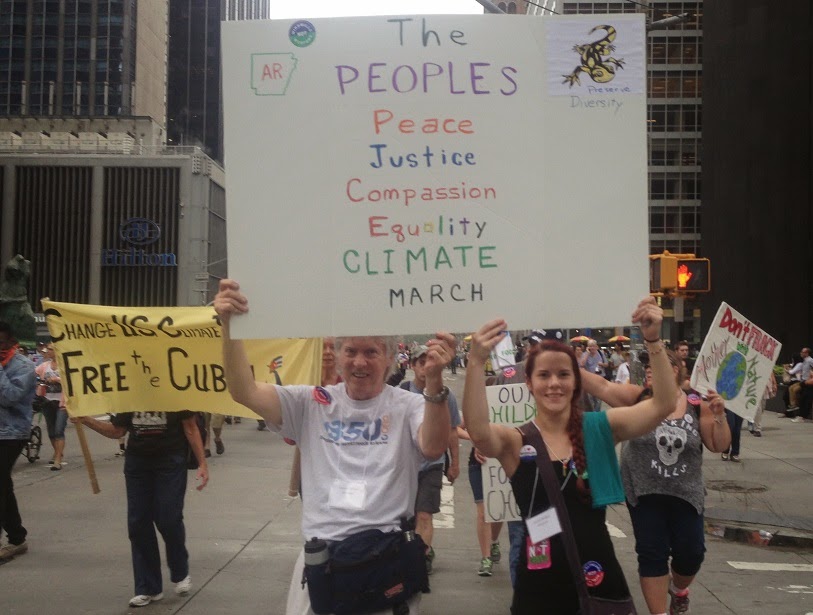
Peoples Climate March—my experience. I was #112, the last person to be accepted for the Arkansas buses to NYC. We left LR very early Friday morning, stopped at Oak Ridge, Tennessee for a program on Global Warming . Some of us had signed up too late for a security clearance to enter Oak Ridge so we had to spend that time on a nice beach on the Clinch River miles upstream from the ash dump at Kingston, TN.

We spent the night at the hamlet of Bulls Gap, TN, where we picked up the last to join us. We had folks from all over Arkansas and from Oklahoma, Missouri, Tennessee, Mississippi, and Alabama. Ages ranged from early teens to around eighty. Families came.

Up early Saturday, to go the length of the Virginia's Shenendoah Valley, very briefly across West Virginia and Maryland and then half the length of Pennsylvania to arrive at Rochelle Park, NJ that night and up early Sunday morning to arrive beside Central Park in NYC to wait for our parade to start at 11:30. Many people were already there when we arrived about 7 AM. We had agreed to stay together, so we scattered. I was with a little core group but I would wander off among the people and out into Central Park occasionally (Central Park is huge with big overgrown areas. There were plenty of porta potties for 200,000 but not near enough for the 400,000+ who participated. I have found I was not the only one to water the bushes in wonderfully over grown areas.)

There were Vegans, Pacifists, Socialists, Communists, Lenin-Marxists, others strongly opposed to all these and then there were others. There were all colors of folks. I talked with a Pine Bluff, Arkansas native NAACPer who brought several teenagers from Milwaukee.

Sometimes New Englanders and New Yorkers would ask where I was from, I assumed because of my Arkansas twang, but I felt they were just curious. Folks were very nice. And interested to talk with someone from Arkansas.

I never felt pushed, physically or otherwise in New York.

There were cops everywhere. My seat mate for the trip, Guerlermina, was from Monterey, Mexico via Chicago and eastern Oklahoma, good Catholic, widowed in 1972 with 5 young children, who recently married a Republican Methodist. Mina got her photo taken twice with pairs of cops holding her arms from either side, all grinning.

This was an exhausting trip. I never heard a speech that moved me. But I felt the whole time (until the Monday night at 10:30 arrival back in Little Rock.) that this mass of people, many of whom probably sacrificed greatly to go, want to save God's Green Earth from the eminent disaster, (referred to as "Progress" by many) we are close to.

I am ready to go again.

By Rel B. Corbin, guest post.
Join us on Friend to Friend on Climate
 

Thursday, September 25, 2014

Ryan Boswell, Guest

The People's Climate March was far and away a greater success that I ever could have imagined. My experience started at 5AM the Friday before the march. I jumped on a bus that would caravan from Little Rock with more than one hundred others from around the region. On the way to New York, we divided the drive into two days, and picked up a handful of passengers on the route from Arkansas across Tennessee. We stopped for the day after the first twelve hours of driving, which destined us for a visit to the Climate Change Science Center at Oak Ridge National Laboratories. We heard from three climate scientists about the impacts of climate change in the Arctic Circle and how trees are responding to increased temperature and atmospheric carbon. It was truly fascinating work – enough to keep one hundred people engaged after twelve hours on a cramped bus.

The next day we made the long and uneventful drive to outskirts of New York, where we rested up for the Sunday's big event. We woke early and traveled into the city. In a way it was eerie how quiet New York was that morning; the city that never sleeps seemed to be in a trance, as if it already knew what was going to unfold. Police and march organizers were everywhere, skillfully coordinating the more than 500 buses traveling from around the country. We were off the bus with three hours to go before the march began, but already the route was buzzing with people. I walked up and down Central Park West to get a handle the crowd.

I couldn't believe my eyes. People impassioned by all manner of issues were joining together under the common cause of climate change. The crowd was so diverse and sometimes at odds: from peace-loving grandmothers to youth demanding a climate-just future; anti-nuclear and pro-nuclear camps; vegans, vegetarians, and omnivores; indigenous communities, faith leaders of all stripes, anarchists, socialists, liberals, conservatives. It was unlike anything I've ever seen. Despite our sometimes polarizing motivations, when it came time to march, we marched together – all 400,000 of us – in recognition that we all share only one planet. As we milled about, waiting to march, my cell phone buzzed with a message from the PCM organizers.

"Moment of Silence at 12:58 PM. At 1:00 PM, sound the alarm on climate change."

I thought the quietness of the city was unsettling in the morning, but when a clamoring crowd of 400,000 suddenly fell silent in unison, it sent chills down my spine. More powerful yet was the moment the silence broke. I was somewhere near the middle of the mass of people and from both ends of Central Park West, the "alarm" of voices, instruments, and noise-makers came cascading through the streets like a battle cry.

The march lasted several hours and quadrupled the turnout anticipated by its organizers. The crowd slowly began to disperse, and I split off for my bus. At 8PM that evening, we departed New York and drove 26 hours straight through to Little Rock. By the time I made it home, my voice was mostly gone and my muscles were cramped from hopeless attempts at sleep, but I had never felt better. I knew that march was the most important thing I had ever done. For the first time in my life, I felt like I really knew what it meant to live in a democracy and to be a part of meaningful social change.

By Ryan Boswell, guest post.
Join us on Friend to Friend on Climate
 

People's Climate March

My heartfelt thanks to the many of you who supported those of us who went to New York City for the People's Climate March (PCM) on your behalf. Here is our report back to you, beginning with a few numbers.

We took 110 passengers on two buses. Two-thirds were from Arkansas, nearly a third from Tennessee, and half-a-dozen from Missouri, Oklahoma, Mississippi, and Alabama. There were five families, a dozen teenagers altogether, nearly fifty college students (from UCA, Sewanee, and at least four other campuses), non-students in their 20s to 50s, and quite a few seniors (including me). The age range was 13-70. We had racial and ethnic diversity, a range of educational backgrounds, differing religious and faith perspectives, and varied life experiences. This diversity was by design and by providence.

So we did not agree on every point, of course, but what this motley crew had in common was (1) a commitment to fighting man-made global warming and climate change, (2) the awareness that this requires an equal dedication to justice and equality, and (3) a deep sense of compassion and consideration toward all. Our two buses were in essence a microcosm of the PCM.

I should add that on a trip like this there was plenty of opportunity for grumbling and complaining. What I experienced, however, as did all I believe, was patience, graciousness, and frankly love. Remarkable!

The big number is the size of the march itself. One early estimate was 310,000, but by the end of the day many counts were over 400,000. Expectations had been high, but we more than doubled these. The crowd spanned many NY city blocks, took hours to BEGIN marching, and had to be dispersed before the official end of the march due to its size. The motto had been, "to change everything we need everyone" and it seemed as though everyone had shown up.

Ours were among 550 buses plus a number of trains, vans, and rideshares, about 30,000 people from outside the region. In a sense we hardly mattered, with all buses being less than 8% and our own less than a fifth of 1% of the total crowd. In the important sense, though, this is exactly what the march was ALL about. We saw signs from nearly every state and we were representing many more who wanted to be there.

Furthermore, there were at least 2646 other events in 162 countries demanding action on climate change. "Now, more than ever, we are a big, beautiful, unified movement coming together around the world to demand a brighter and more just future for everyone."

The perspective I take from this experience is that humankind is indeed one. Until we understand this fact we are doomed to destroy the Earth and create our own hell. When we truly understand our interconnectedness, however, we can begin to build a world of justice, peace, and prosperity.

Join us on Friend to Friend on Climate

Saturday, August 16, 2014

Why March? A New Vision

When I asked the question "Why March?" three weeks ago, my vision was focused on the entire planet. I was looking for a glimpse of how traveling from Arkansas to New York City for the People's Climate March (PCM) might help "galvanize and catalyze action" at the UN Climate Summit. What decisive steps in reducing carbon emissions worldwide would likely come as a result? Perhaps such a global vision was too narrow. Maybe what I was and am looking for is a broader perspective that appreciates this opportunity to arouse action here at home.


Here is the vision now emerging.
The Arkansas bus trip to the People's Climate March shall be:

Collaborative

The Arkansas bus trip is clearly a collaborative effort, not just between bus co-captains, but among members of the team we are building and the organizations standing behind us and working with us: the Omni Center for Peace, Justice, and Ecology, the Sierra Club (Ozark Headwaters and Central Arkansas Groups), Arkansas Interfaith Power and Light, to name a few. And honestly, no one and no group will be left out. As the PCM organizers state it, "To change everything, we need everyone on board." Our goal is to expand the number of Arkansans working toward good jobs, clean air and water, and healthy communities.

Inclusive

Our intention is to recruit passengers of diverse age, gender, race, ethnicity, economic status, religious affiliation, and life experiences. This is to include students, those in a variety of jobs, professionals, and unemployed. Some participants may be relatively new to environmental issues, others old hands, and still others personally affected by the issues. For some, activism will have been a way of life, for others the march will be entirely new. I daresay it will be a unique experience for all. In fact, YOU too can sign up here. Our goal is to broaden the group/groups of Arkansans working keep our air and water safe and the Earth livable.

Educational

Participating in the PCM will be an education in itself, but the bus is equipped with WiFi and DVD player. We'll show Bill McKibben's Do the Math, Velcrow Ripper's Occupy Love, and other documentaries. Additionally, we plan a stop at the Climate Change Science Institute (Oak Ridge National Labs) to spend time with their experts. And there will be plenty of time for discussion on the bus. Then we wish to bring this knowledge back to those who have sent us. Our goal is to teach ourselves and deepen the level of understanding among our friends and neighbors.

Inspiring

As if participating in "the largest climate march in history" would not be inspiring enough, the plan as we march through Times Square is for video feeds from around the world to be shown on the massive screens. After the march we want to allow passengers who so wish to participate in the Religions of Earth multi-faith celebration at the Cathedral of St. John the Divine before returning home. Our goal is to be inspired and to inspire each other to believe in a better world.

Fun

What would a bus trip be without music and games and snacks and laughter? Our goal is to celebrate life.

Crowdfunded

The cost of the bus trip per person is reasonable and many passengers will choose to pay their own way. We have also received a couple substantial donations and several sponsoring donations to help low-income individuals afford to come with us. But we think it would be great if a significant portion of the expense could be crowdfunded. What this means is many (up to 1,000) small donations (of $3-30). I am using my birthday wish list as an excuse to set up a crowdfunding page if you would like to be a part of this. Our goal is to allow everyone to participate as they are able.

Awareness Raising

(1) Before the trip, publicizing the event, recruiting passengers, and soliciting donations will help inform many across the state of these events who otherwise would not have heard. (2) As travelers and marchers, we will raise our own level of interest and understanding, and we will send back live tweets, text messages, and social media postings to those at home. (3) After the trip, we plan to document our experiences and publish them online and in the media. Our goal is to raise public awareness of issues throughout Arkansas and to inspire increasing public participation in their solutions.


Notice a Theme?

The People's Climate March is all about people. Our goals are to expand, broaden, deepen, and celebrate our experience as community. May it be so.

Three weeks ago I was simply one person seeking a way to become part of the largest climate march in history. Would I travel by myself, or could I find a group from around here to tag along with? Then to my surprise I found myself volunteering to become a bus captain. Are you kidding me? Me, a bus captain? Yet as I started tiptoeing forward, my home town bus company helped me see that the monsters I had imagined were not so scary. Maybe this wouldn't be so bad after all, but I was still feeling pretty lonely.

Fortunately, a kindred spirit from Northwest Arkansas, Edward Hejtmanek by name, had been asking the same questions and coming to much the same conclusions. After a mutual friend put us in touch, we decided to throw in together and become PCM bus co-captains. What a difference that has made. Details, lots of them, remain to be worked out, but what is emerging is the vision outlined above of how the global Climate Summit can help catalyze local action right here in Arkansas. But don't misunderstand. We ARE going to New York, and we DO still want to be part of this historic march. It is just that this trip is no longer about filling one more bus to meet up with 400 other bus-loads and tens of thousands more carrying signs and shouting slogans. This trip is about raising awareness here at home of others in our communities who are standing up for a just, safe, peaceful, and healthy world. It is about forging new connections and renewing old ones, about organizing and shifting power so that effective steps are imaginable. This is our emerging vision.

Please join the conversation on
Friend to Friend on Climate

Find out more about it at
PCM: Arkansas Bus

Tuesday, August 5, 2014

Friend to Friend

What can I say to a new friend who is not familiar with climate change, but who is neutral and open-minded? How can I help her understand the magnitude and urgency of the issues without overwhelming her or worse still sounding like a raving fanatic? What should I say to an unbiased person who genuinely wants to understand what climate change is all about? Here are a few bullet points:

  1. The Earth's climate has been stable for ten thousand years.
  2. Since 1900, the Earth's average temperature has increased substantially, a trend even more noticeable since 1980.
  3. Almost all of the warming is attributable to human activities, particularly emissions of greenhouse gases: carbon dioxide and methane.
  4. Already we are seeing the destructive effects on human existence of climate change related to global warming.
  5. The dire consequences of continuing at this pace are hard to imagine and almost impossible to exaggerate.

The Science

  1. Consensus: 97% of climate scientists are in full agreement with points 1-3 above and in substantive agreement with points 4 and 5.
  2. Most of the leading scientific organizations worldwide have issued public statements endorsing this position.
  3. The Intergovernmental Panel on Climate Change (IPCC) Assessment Reports provide detailed discussions of this position.
  4. The National Climate Assessment (NCA) Report of 2014 summarizes the impacts of climate change on the United States, now and in the future.

The Politics

  1. To mitigate climate change, aggressive reductions of greenhouse gas emissions are needed by the United States and other nations.
  2. The threatened fossil (carbon) fuel industry has been bankrolling an immense campaign of disinformation using "doubt and delay" tactics.
  3. This campaign is precisely reminiscent of a similar campaign by Big Tobacco against the health risks of tobacco several decades ago.
  4. Technology is available now to economically and effectively switch to renewable clean energy sources if we have the political will to do so.

The Moral Choices

  1. The effects of global warming will persist for hundreds of years. What are our responsibilities and duties today to help safeguard the distant future?
  2. The devastations of climate change disproportionately affect the vulnerable and disadvantaged. What are our responsibilities to "the least of these?"

The March

  1. In a bottom-up approach, nations take on self-determined obligations based on national priorities and circumstances: a “mosaic world.”
  2. In a top-down process, a growing set of nations take on increasingly ambitious greenhouse gas emissions targets and carbon markets playing a central role.
  3. Tension over these approaches are on display as nations commence serious negotiations to develop a post-2020 agreement to be concluded in Paris in late 2015.
  4. "UN Secretary-General Ban Ki-moon has invited world leaders, from government, finance, business, and civil society to Climate Summit 2014 this 23 September to galvanize and catalyze climate action."
  5. The People's Climate March is "an invitation to change everything."

Please join the conversation on
Friend to Friend on Climate

Saturday, August 2, 2014

Why March? Second Thoughts

I still want to join the People's Climate March (PCM) in NYC, and I still hope to help make it possible for a bus-load of others to go too. But if such a bus does not materialize, will I make arrangements to go myself or with a smaller group? That is my question this morning.

If I go by myself I will fly, of course, but the irony of taking a plane to a climate march is not lost on me. A bus trip is four times more carbon efficient per person. On the other hand, going by train or automobile (even my Prius) is only about twice as efficient and less convenient. Let's face it long distance travel in this country is carbon intensive no matter how you go. This leads me to ask:

What is important?

The occasion that has spawned the PCM is the planned UN Climate Summit two days after the march. This will be a crucial meeting at a crucial time, and global media attention will be (or should be) focused on New York City. Here is the semi-official announcement.

UN Secretary-General Ban Ki-moon has invited world leaders, from government, finance, business, and civil society to Climate Summit 2014 this 23 September to galvanize and catalyze climate action. He has asked these leaders to bring bold announcements and actions to the Summit that will reduce emissions, strengthen climate resilience, and mobilize political will for a meaningful legal agreement in 2015.

Leaders from over five hundred organizations have seized this opportunity to make a demonstrate that 'the people' are serious about climate change and that we expect our leaders to share our concern by leading boldly.

With our future on the line, we will take a weekend and use it to bend the course of history. In New York City there will be an unprecedented climate mobilization – in size, beauty, and impact. Our demand is for Action, Not Words: take the action necessary to create a world with an economy that works for people and the planet – now. In short, we want a world safe from the ravages of climate change.

This is the invitation that grabbed my attention, and started me planning to travel to NYC and join this historic march. I hope there is a HUGE turnout and I want to be one of those present.

On the other hand

Even the march organizers acknowledge the limitations of what can be accomplished at the summit and by the march:

We know that no single meeting or summit will "solve climate change" and in many ways this moment will not even really be about the summit. We want this moment to be about us – the people who are standing up in our communities, to organize, to build power, to confront the power of fossil fuels, and to shift power to a just, safe, peaceful world. To do that, we need to act – together.

One of the participating organizations (the one most instrumental bringing the march to my attention) is Greenfaith. Here is what they have said on the People of Faith People's' Climate March Facebook page:

Thousands of people of diverse faiths will be taking part in the People's Climate March this September 21 in New York City. Thousands more will be holding observances in their own communities on the day of the March. This Facebook group is a place to find out what's going on in New York City and your own area, and how to find resources that will help your faith community mark this witness for a sustainable climate for all.

In other words, the march in New York City a big deal, but it's not the only deal and it's not the only way to participate in the movement.

A page from Peace Day's playbook

It has not escaped my attention that September 21 is also the International Day of Peace. Hundreds of organizations are promoting this event around the world, perhaps none more avidly than Peace One Day.

Peace Day is an opportunity for UN agencies and NGOs to focus their ongoing life-saving activities within a global context. The impact of a day of global ceasefire and non-violence cannot be underestimated. Throughout the years, millions of people have been active on Peace Day in every country of the world, and hundreds of organizations have carried out life-saving activities in areas of conflict.

Since 2007 humanitarian and life-saving Peace Day activities have take place all over the world, contributing towards peace-building, development, and aid, including the delivery of supplies like mosquito nets, food, and vaccines, particularly in Afghanistan. These activities have affected the lives of millions. But another major emphasis of Peace One Day is "simply" raising awareness of Peace Day around the world. It was estimated by McKinsey and Company 280 million people in 198 countries were aware of Peace Day 2012. Last year that number increased to 470 million people in 200 countries, and their goal is reach 1.5 billion people in 2014. That would be amazing. Really.

Raising Awareness

How many people are or will be aware of the UN Global Climate Summit, September 21 (and to what degree)? Without engaging a company such as McKinsey, we probably have little way of knowing or even estimating accurately. But the actual number does not really matter. What does matter is that for those who cannot go to New York City to participate in the PCM, what all of us can do is raise awareness of the march and the summit. This is no insignificant achievement. I encourage each who reads this to share with everyone you can in as many ways as you can.