Sunday, February 26, 2012

Another War, Really?

I am no policy wonk, especially foreign policy, but I am concerned about the recent escalation of saber rattling toward Iran. War should always be the last resort. A hardline stance toward Iran may be appropriate (or may not), but Senate Resolution 380 if adopted could make military conflict more likely.
  • The war in Iraq has cost the U.S. $100 billion a year, more than $800 billion total. How can our economy afford a war with Iran?
  • The U.S. has thousands of nuclear weapons, Israel hundreds. Why are we assuming that suddenly, deterrence will not work with Iran anymore? Military leaders see no such threat.
  • What are the views of the Iranian people in regards to a potential war and the current sanctions? Is this path helping us win or lose hearts and minds in Iran?
  • Given the controversy over our intelligence on Iraq, how are we factoring in and addressing the uncertainty of intelligence on Iran's nuclear program?
  • Why are many ignoring intelligence reports that see no move by Iran to build a nuclear bomb?
  • Could it be that the increasingly bellicose and confrontational approach of the West actually increase Tehran's desire for nuclear deterrence?
  • A tense exchange is currently playing out in public between the Netanyahu government and the U.S. military. What lies behind the starkly diverging views of the Netanyahu government and the U.S. military on Iran?
  • My worry has long been the idea of terrorists getting material to make "dirty bombs" that could be smuggled into Israel or the U.S. It is much more likely, however, that this material would come from Russia or Pakistan than from Iran.
  • I am no expert in Middle East policy, but these are a few reasons I see to lower the rhetoric and avoid war with Iran.

(Thoughts derived from an article in the Huffington Post.)

See also donnal.net

Digging Deeper Again

The biggest problem with digging deeper for me is that it takes time. That is what digging deeper means, taking the time to seek out new information, organize the material, and work to articulate the findings. Recently I have had a number of other projects to work on (such as refurbishing donnal.net), so I have not been doing much digging. At least for a few posts, I hope to change this.

Saturday, September 24, 2011

Ngram view of Meditation

This morning I reviewed 5 million books (5 billion words) looking for references to meditation and forms of prayer. Oh by the way, I had a little help from Google Labs.

It all started with a TED talk that I watched Friday night by Erez Lieberman Aiden and Jean-Baptiste Michel. In this talk they demonstrated the free Ngram Viewer from Google Labs / Google Books. What a cool tool. When you enter phrases into the Ngram Viewer, it displays a graph showing how those phrases have occurred in a corpus of books (e.g., "English") over the selected years.

What word or phrase should I look up first? Since I have had an interest in meditation, I decided to look up the occurrence of the word "meditation" in books from 1700 to 2000.

This is fascinating because there is a distinct peak around 1820, a fairly deep valley between 1920 and 1940, and full recovery by 2000. It is also interesting to note two smaller shoulders around 1930 and 1980. It is not entirely clear (to me) what the Y-axis means (especially when we get to phrases later), but I interpret this to mean that at both peaks (1820 and 2000) the word "meditation" occurs about 10 times per million words examined (0.001 %). The valley is at 4 per million.

So I wanted to see how this compares with the word "prayer."

The word "prayer" has a distinct peak around 1840 that is eight times higher than "meditation" (83 per million), after which this is steady decline to 21 per million around 1975. Notice that there is no recovery after 1940 and only a slight recovery after 1980 to 26 per million. The curve for "meditation" is the same as in the first graph above, but on a different scale.

Next I wanted to compare "meditation" to the words "mysticism," "mystic," and "mystical." Note the timeline starts at 1800. This is a busy graph, so we should look at one line at a time. The "meditation" graph is in yellow here. I find it highly curious that the graph for "mystic" (red) is nearly upside down from "meditation" with a peak at 9.5 per million around 1930 and a steady decline since then, with no recovery. "Mysticism" is lower and parallels "mystic" but with less of a decline after 1930. The word "mystical" (green) is also similar except that it recovers after 1940 and remains steady since 1960.

Since the words are related, it should not be surprising to see a similar shoulder around 1930, but that does makes me curious about what was going on then. It is also interesting that of these three words, only "mystical" recovers after 1940 while the other two have continued to decline. Strange too (or not) that all four of these words are within the range of 3-12 per million. For comparison purposes, the word "centering" is found infrequently until the early 1900s, but since 1920 it has been relatively stable between 1.6 and 2.4 per million, with a slow decline since 1940.

Next I was interesting in comparing and "transcendental meditation" with "contemplative prayer." Notice that we begin with 1900 in this graph and also note that the Y-axis is greatly expanded (showing a much smaller range). The phrase "transcendental meditation" (in blue) does not occur until about 1960, after which it rapidly rises to 0.016 per million or 16 per billion. There is a distinct peak at this point and then it declines to half that or 8 per billion and levels off since 1990. By contrast, the phrase "contemplative prayer" has had a nearly linear growth since 1910 until it is over 6 per billion by 2000. For comparison, the term "centering prayer" was essentially unheard of until 1970 since which time it has had a linear increase to about 1 per billion. I then added the single word "zen" to the search, and was somewhat surprised to find that its occurrence does not dwarf that of these phrases, although it has enjoyed an increase since 1950, the low point of this century.

So I then compared four kinds of prayer: "contemplative prayer," "intercessory prayer," "meditative prayer," and "centering prayer." This graph starts at 1950. Maybe I should not have been, but I was quite surprised at how closely the lines for "contemplative" and "intercessory" prayer line up. It is almost as those they almost always occur together (even in the same sentence). The nadir is not distinct, but occurs around 1970 (2-3 per billion), and both have steadily increased to nearly 7 per billion.

What makes the above observation all the more remarkable is that before 1950 these two phrases did not parallel at all. "Intercessory prayer" peaked at 14 per billion around 1850 at a time when "contemplative prayer" was quite rare.

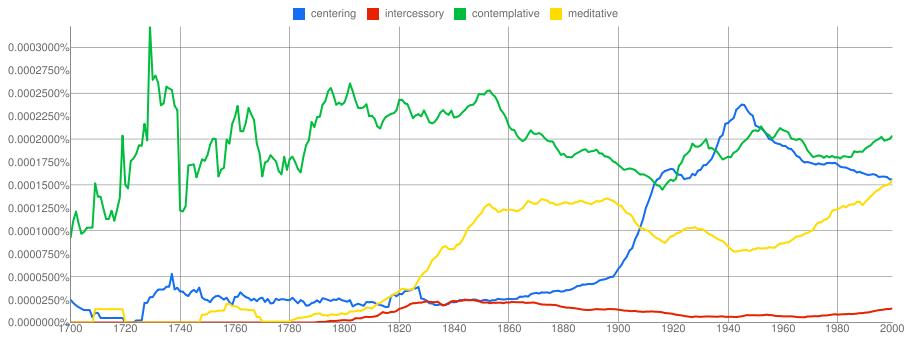
One might wonder if the incidence of the phrases has anything to do with the incidence of the adjectives themselves. Apparently not. (Range 0-3 per million.)

Wednesday, August 31, 2011

What troubles you?

We all have worries. Facebook makes this clear. Some of us share our troubles more openly than others, but reading Facebook for a week shows that we all struggle with something. Maybe it is a family concern, losing a job, damage from a storm, or a sick pet; the list is endless. It is normal (and appropriate) to get caught up in these worries, and it is not unusual to be overwhelmed by them. We simply don't have the energy to focus on yet one more thing.

You all have great hearts. If I were to ask for help with a personal struggle, dozens of you would be right there offering to help. Yet if I were to ask you to think with me about a more global issue, most of you would scroll right on past. That is normal; I do it too. Today I am asking you to pause another minute or two and read what is on my mind and in my heart.

Many of you know that I support organizations that help feed the hungry and provide clean drinking water for those without. Because these issues have a personal face they appeal directly to my compassion. The topic I want to discuss with you today, however, often seems less personal. The topic is climate change and global warming. Climate change can appear impersonal because we make it into an economic or political issue; we talk about "carbon dioxide" and "green house gases" or about fuel efficiency and alternative forms of energy. How impersonal is that? But then one day I read about the thousands who will suffer as coastlands are flooded with the rising oceans. I see the destruction left in the path of killer tornadoes and once-in-a-century hurricanes. I watch the children starving from famine caused by the drought in Somalia. These tug at my compassion again.

If they tug at yours, you might still feel powerless. It is easy to be overwhelmed, both by the magnitude of the problem and by your own important concerns. Maybe your emotional energy is running on low right now. Fortunately, Facebook makes it easy to begin simply by raising awareness. You can do as little or as much as you are inclined to do.

  1. Click "Like" on the Facebook link to increase interest.
  2. Post a "comment" on that link to show your support.
  3. "Share" this link on your wall to spread the word.
  4. "Like" the following pages:
    Climate Reality |
    Stop Global Warming
  5. RSVP to 24 Hours of Reality event.
  6. Post a "link" to Climate Reality Project
  7. "Donate your Facebook" to 24 Hours of Reality

Now, I know that some of you are probably skeptical. You will claim we don't know for sure that the natural disasters I mentioned above are related to global warming. Some of you might even say we can't prove that global warming is due to human activity. All I am asking today is that you keep an open mind. In my studied opinion, the scientific evidence that climate change is real and that it is cause by human activity is undeniable. Are specific weather events the direct result of global warming? I grant that the evidence for this is not as incontrovertible, but it is quite solid nonetheless. For those who want to dig deeper, see: Science of Global Warming

Of course a few of you will remain unconvinced. You will claim this is nothing more than a big hoax, the result of political hype, or a grand conspiracy. Again I appeal to you to keep an open mind. These are the kind of accusations that were made against the science smoking and health while hundreds of thousands of Americans were losing their lives due to smoking. The tobacco industry set out to perpetrate a lie. Now everyone knows the truth about smoking.

Compassion means "to suffer or endure with." We all suffer troubles of one sort or another and these may overwhelm us. It is easy to become absorbed in our concerns. My purpose in this project is to raise awareness of ways we can take a step outside of our concerns and respond with compassion.


Science of Global Warming

Sunday, August 21, 2011

Concerned about mercury?

If you aren't, you should be. This topic came up a few weeks ago in a Facebook conversation about the government regulations requiring light bulbs to be more energy efficient. The argument was that the government should not take away our right to use inefficient bulbs if we so choose. The "market" should control usage. Maybe we just like incandescent bulbs better, or maybe we are worried about the fact that the new compact fluorescent light (CFL) bulbs contain mercury. It seems wrong that our government should force us to use products that create toxic waste. Should we be concerned about mercury? After digging deeper this is my answer:

  • Yes, we should be concerned about mercury, and
  • The mercury case against CFL bulbs is entirely bogus.

Mercury is a naturally occurring but rare element in the Earth's crust. The element and most of its compounds are extremely toxic causing harm to the brain (especially developing brain), heart, kidneys, and immune system at all ages. Fortunately the toxic effects are not caused by low levels of mercury, but unfortunately mercury is difficult to eliminate, so it tends to accumulate in the body over long periods. A highly toxic form, methylmercury, builds up in fish, shellfish and animals eat fish. About half of the mercury in the atmosphere comes from volcanos and other natural sources, but mercury is an often overlooked and serious component of man-made air pollution. The five biggest sources may surprise you.

  1. Coal-fueled power plants (40-65%)
  2. Gold mining (11%)
  3. Coal-fueled cement kilns (6%)
  4. Chlor-alkaline plants (3%)
  5. Trash incinerators (3%)

What about CFL bulbs? Even if disposed of improperly, fluorescent bulbs of all kinds would never represent more than a fraction of a percent of the total mercury pollution. If recycled properly, on the other hand, they are perfectly safe and cause no pollution whatsoever. Here are a few links about recycling bulbs.

If we are concerned about mercury pollution, which we should be, and if our concern is genuine rather than an excuse for complaining about energy regulations, we should look on CFL bulbs as one means of lowering mercury emissions by lowering consumption of electricity produced by coal. Those who use mercury content as a reason to repeal the energy regulations say almost nothing about long fluorescent bulbs found in their workplaces, businesses, and shops (even in their own homes). Most ingenuous, they are silent about coal-fired power plants. They claim to be worried about mercury, but obviously they are not.

The problem with digging deeper is knowing where to stop. Each of the above sources of mercury pollution deserves a discussion of its own.

  1. Proposed Turk Power Plant in Southwest Arkansas
    ("clean coal" controversy)
  2. Toxic jewelry and the new gold rush
  3. The Ash Grove Cement kiln in Forement, AR
    (pros and cons of tire-derived fuel)
  4. Ashton Chemical Chlor-alkaline plants in Ohio and El Dorado, AR
  5. ENSCO (El Dorado, AR) and Reynolds Metal (Arkadelphia)
    toxic waste disposal

Sunday, August 14, 2011

An Experiment in Giving

It is with some trepidation that I write this entry about giving, my hesitation stemming from reading Matthew 6:3-4:

But when you give to the needy, do not let your left hand know what your right hand is doing, so that your giving may be in secret. Then your Father, who sees what is done in secret, will reward you. (NIV)

Nevertheless, I am writing anyway because: (1) I currently have almost no blog followers, and (2) I won't post a link on Facebook (which is how most readers find my posts) for a while, maybe a month or possibly up to a year. Besides, what I am doing is not exactly secret anyway. Here is the experiment.

For an unspecified period of time, I have decided to make a $5.00 donation to a worthy cause in the name of each of my Facebook friends on their birthdays. I will inform them of their gifts by posting on their Facebook walls. Why am I doing this? First, I hope each one will feel honored; that is my intent. Second, this is a more personal way of raising awareness for causes that are important to me. Third, mutual friends will be able to see the posts and others may be inclined to give too.

Here are my guidelines. (1) These donations are in addition to, and apart from, my family's main charitable giving, which is to our church (St. Margaret's Episcopal Church). (2) To make it easier to donate a number of small amounts to various causes, I have chosen to use causes.com (Facebook app). (3) These gifts are to be as non-controversial as possible. For example, one of the causes I would like to support (and raise awareness of) is reducing or eliminating climate change. I will, however, only donate to this cause in the name of those who (to my knowledge) support this cause too. (4) No gifts will be political. (5) Here is a partial list of the organizations I will start out supporting. I may or may not edit this list as time progresses.

  1. Oxfam America
  2. water.org
  3. 1sky.org - 350.org
  4. Freedom from Hunger

Incidentally, I have never been a big financial supporter of political causes, but for the coming year I have decided to make no political contributions whatsoever. This is partly just a personal decision, and partly in support of Howard Schultz (Starbucks) in his effort to boycott political contributions.